You’re looking for something to soften the appearance of fine lines, but your first question isn’t, “How quickly will it work?”
It’s, “Will my skin tolerate it?”
Perhaps you’ve bought a promising serum before, only to feel that familiar sting and wonder whether you should wash it off. Now, in your 40s or 50s, you want to care for the changes you’re seeing without upsetting a routine your skin finally feels comfortable with.
PDRN sounds interesting. But then you start comparing bottles: 1,000 ppm, 10,000 ppm, “high potency.” Does a bigger number mean better results? Does it tell you anything about the chance of irritation?
For someone managing sensitive skin through Australian summers, sunscreen and everyday skincare, those questions matter. Before adding another serum, you deserve to understand what the label actually tells you—and what it leaves unanswered.
A higher PDRN number cannot tell you whether your skin will tolerate a serum. Start with what the number measures, the complete formula and evidence for that particular product. Strength alone is a poor way to choose something you hope to use comfortably.
“I want to try PDRN. I don’t want to start over with my skin.”
You might notice fine lines more when you put on makeup, or find yourself looking for something that leaves your skin feeling comfortable as well as looking smoother. Wanting those things is reasonable. So is being cautious after a previous reaction.
For this decision, the useful question is quite specific: does this particular PDRN product offer enough information to justify trying it in a routine that already suits you?
PDRN stands for polydeoxyribonucleotide, a preparation of DNA fragments. If you want the broader background, our PDRN science and hype guide explains the difference between cosmetic products and injectable research. Here, we’re staying with the bottle you might buy for home use.
What does 1,000 ppm actually mean?
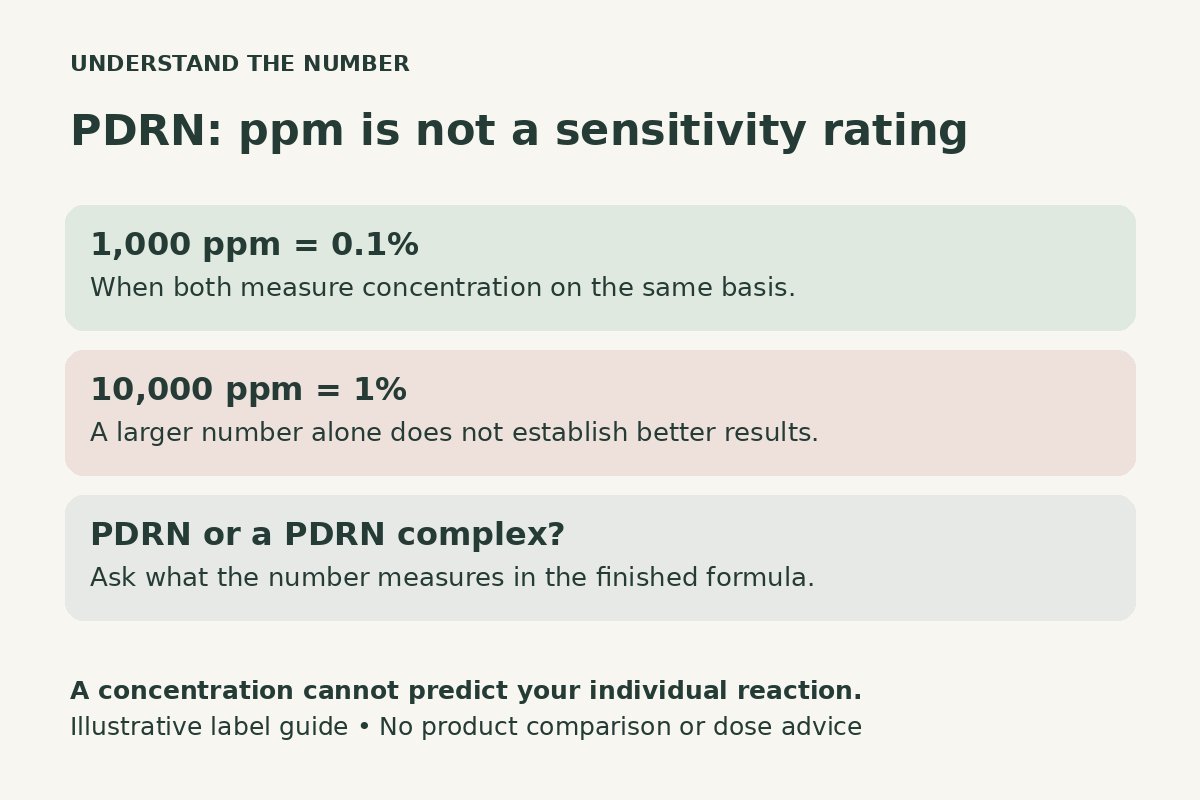
“Ppm” means parts per million. When a concentration is expressed on the same basis, the conversion is straightforward:
- 100 ppm = 0.01%
- 1,000 ppm = 0.1%
- 10,000 ppm = 1%
These are mathematical equivalents, not recommended doses or sensitivity ratings.
The next question matters more than the conversion: parts per million of what? A claim may describe PDRN itself or a named ingredient mixture. Ask whether it refers to the amount in the finished serum and whether it measures the PDRN content or the amount of a blend added during manufacture.
If the wording leaves you guessing, ask the brand. You should not have to work out the composition from a large number on the front of a bottle.
Two imaginary labels—and the question to ask
Imagine one bottle states “PDRN 1,000 ppm in the finished formula.” Another states “10,000 ppm PDRN complex.” These are fictional examples, not descriptions of products we have tested.
The second number looks larger, but the wording does not establish how much PDRN the complex contains. It could include a carrier or other ingredients. Until the brand clarifies that composition, you cannot make a direct comparison.
Even if both brands confirm the actual PDRN concentration, that still leaves your original question unanswered: will your skin feel comfortable using either formula?
Does a higher PDRN concentration mean better results after 40?
The clinical evidence does not give us a universal concentration to shop for.
A 2026 study tested a particular 0.1% PDRN eye cream against 0.1% retinol in the same cream base. The split-face trial involved 31 women aged 35–55 and lasted 28 days. It reported improvements in several eye-area measures and good tolerability with the PDRN preparation. Read the original study.
That is an interesting starting point for a reader concerned about fine lines and sensitivity. But it was a small, short study without an inactive cream comparison. It did not compare different PDRN concentrations, establish long-term results, or test every serum carrying the ingredient name.
You cannot use it to conclude that 1% works better than 0.1%, that PDRN replaces retinol, or that another product will suit your skin. Some authors also had skincare-company affiliations, which is useful context when weighing the findings.
“Gentle” on the bottle is not a promise about my skin
When you have reacted to skincare before, the complete ingredient list deserves more attention than the hero ingredient alone. The American Academy of Dermatology notes that skincare ingredients, including preservatives, can cause allergic contact dermatitis. Fragrance can also be an issue for some people.
This does not mean preservatives are bad or that every fragranced product causes a reaction. It means your own reaction history matters when choosing a formula.
Before buying, ask:
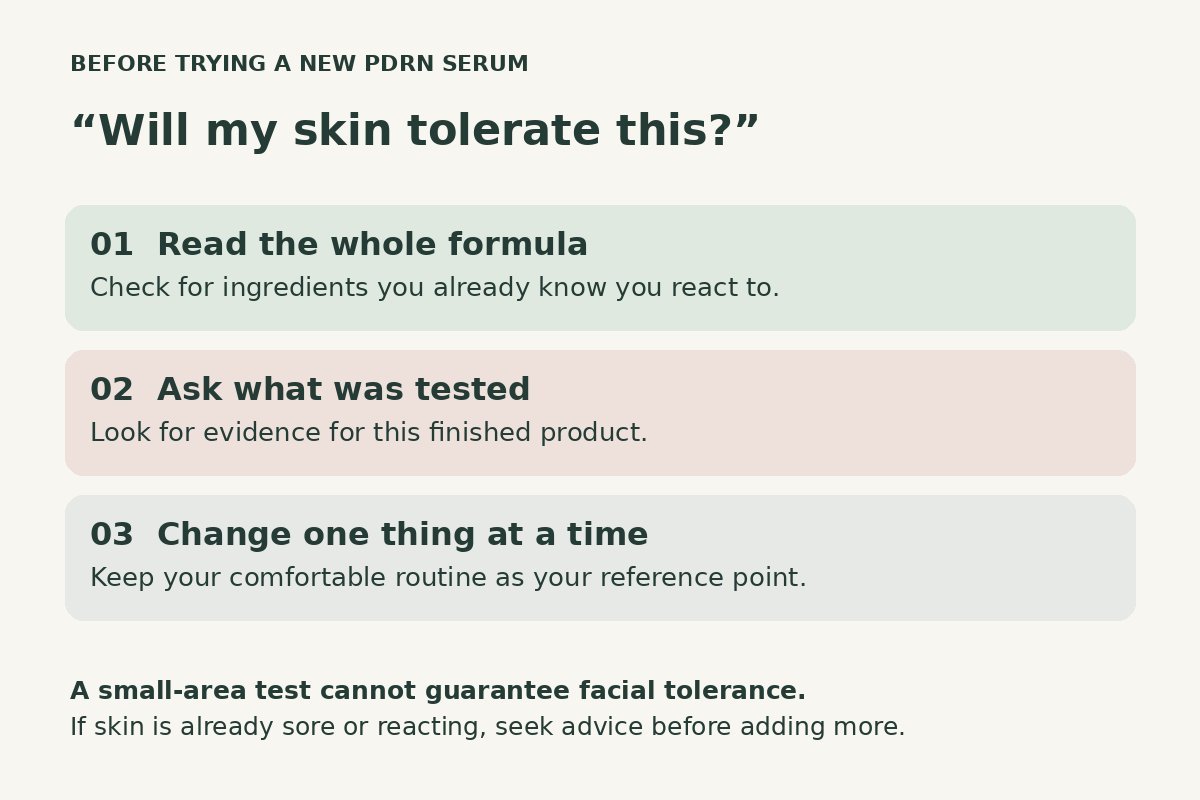
- Is there a complete ingredient list I can check against anything I know I react to?
- Is the concentration claim clear about what is being measured?
- Does the brand have human evidence for this finished product, or is it discussing PDRN research more generally?
- Are its use instructions clear, including where to apply it?
A PDRN product that also contains another active introduces more than PDRN into your routine. If you want to understand how your skin responds, account for the whole formula rather than treating the ingredient on the front as the only change.
How I’d approach the decision: comfort first, then a careful trial
You do not need to buy a PDRN serum today to make a good decision about it. An unanswered label question is a reason to ask for information, rather than a reason to choose the stronger-sounding bottle.
If your routine is comfortable, keep that as your reference point. Introduce one new product at a time, so you can more easily trace any change. Follow the product’s directions rather than adding extra applications because the number sounds low.
For home testing, the AAD recommends a small area on the inner arm or elbow, using the normal amount twice daily for seven to ten days. Stop and wash it off if a reaction develops. This is a preliminary check, not a guarantee of facial tolerance or a substitute for medical patch testing. Recurrent or persistent reactions deserve professional assessment. AAD testing guidance.
If your face is already sore or reacting, get help understanding that problem before choosing a new cosmetic to solve it. There is no need to turn an uncomfortable week into a test of another product.
Where does it fit into an Australian routine?
Think about the morning you actually have: skincare, sunscreen, perhaps makeup, then getting out the door. Would this serum fit easily, or would trying it mean changing several products you already rely on?
Keep your established sun-protection habits in place. PDRN is not sunscreen, and a cosmetic claim about ageing skin does not make it UV protection. Cancer Council explains sunscreen’s role within broader sun protection in its Australian sunscreen information.
You can assess practical comfort as well as appearance: whether you want to apply the product, whether it sits comfortably in your routine, and whether you can use it according to its directions. A purchase does not become worthwhile simply because its concentration looks impressive.
Before you choose a bottle
Return to the thought you started with: “I want to care for my ageing skin, but I’m more worried about a reaction than choosing the strongest serum.”
Use that priority to guide the purchase. Look for a clear label, a formula you can assess, and evidence that matches the product and the outcome you want. Leave room to decide that your current routine is enough.
Before buying, ask the brand one question: “Does this ppm figure describe the actual PDRN content in the finished product, and what evidence do you have for this formula?”
The answer will help you make a more informed choice. Your skin does not need you to win a numbers competition.