Why Is My Skin Getting More Sensitive? How Over-Exfoliation Damages Your Skin Barrier
If you're asking yourself why is my skin getting more sensitive, the answer might be sitting right there on your bathroom shelf. Over-exfoliation is one of the most common and most misunderstood causes of skin barrier damage, and it's affecting Australian skin enthusiasts more than ever. Here's exactly what's happening beneath the surface, and what you can do to turn it around.
What Is the Skin Barrier (and Why Should You Care)?
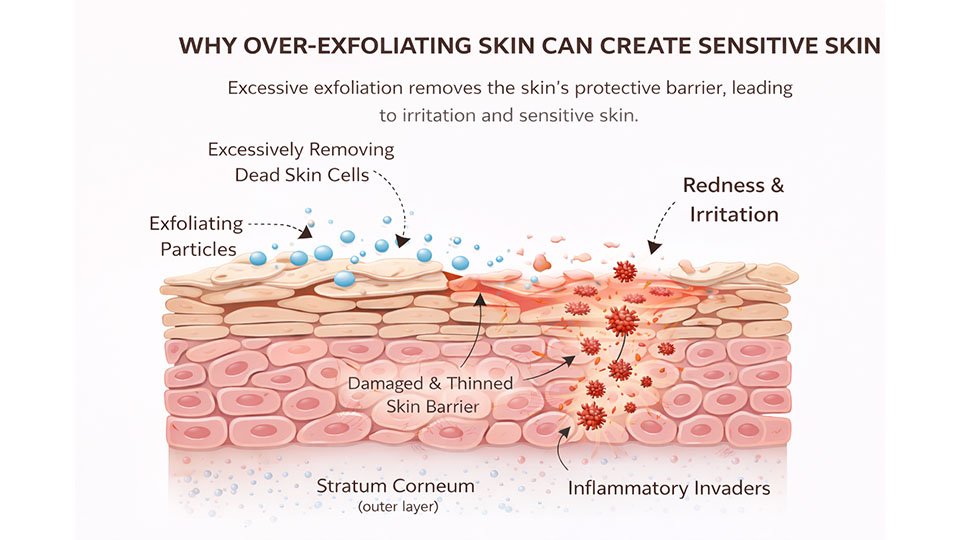
Your skin barrier technically called the stratum corneum is the outermost layer of your skin. It's made up of typically 10–15 layers of dead skin cells (corneocytes) on the face, held together by a carefully balanced lipid matrix of ceramides, cholesterol, and fatty acids in roughly a 1:1:1 ratio. Think of it like a brick wall: the cells are the bricks, and the lipids are the mortar.
This barrier has two critical jobs: keeping moisture in and keeping irritants, bacteria, and environmental aggressors out. When it's healthy, your skin feels plump, calm, and resilient. When it's damaged, water escapes through a process called transepidermal water loss (TEWL), which studies show can increase by up to 50–300% above normal in a compromised barrier leading to the dryness, tightness, redness, and reactivity you might be experiencing right now.
## How Over-Exfoliation Damages Your Skin Barrier
Exfoliation done correctly helps remove the build-up of dead skin cells and supports healthy cell turnover. The problem is that more is absolutely not more.
Chemical exfoliants like AHAs (glycolic, lactic acid) and BHAs (salicylic acid) work by breaking down desmosomes, the protein structures that bind skin cells together. Overuse removes too many cell layers too quickly, prematurely exposing the lower layers of your skin before they're ready.
Physical exfoliants (scrubs, facial sponge, cleansing brushes) can cause microscopic tears in the stratum corneum when used with too much pressure or too frequently. This damage is cumulative, it builds up quietly until your skin suddenly seems to fall apart overnight.
Here's the part that surprises most people: frequency matters more than strength. Research shows that even gentle daily exfoliation can compromise the skin barrier in as little as two to four weeks for sensitive skin types. You don't need to be using a 10% AHA to do serious damage consistent low-level exfoliation adds up.
Once the barrier is compromised, your skin triggers an inflammatory response involving cytokines like IL-6 and TNF-α that causes visible redness, stinging, and heightened reactivity to ingredients your skin previously tolerated without issue. In some cases, this inflammation can persist for two to three weeks even after you stop exfoliating, if you're not actively repairing the barrier.
Sensitive Skin vs. Sensitized Skin: An Important Distinction
Not all reactive skin is the same, and understanding the difference is key to treating it correctly.
-
Sensitive skin is a genetic predisposition. People with sensitive skin naturally have a thinner stratum corneum, a more reactive immune response, and lower natural ceramide production. It's estimated to affect around 30–40% of people in some populations.
-
Sensitized skin is an acquired condition which caused by over-exfoliation, over-treating with actives, or environmental damage. The crucial difference? Sensitized skin is reversible.
Over-exfoliation can turn completely normal skin into sensitized skin. If your skin suddenly became reactive after you ramped up your exfoliation routine, you're almost certainly dealing with sensitized skin. Good news is, it means you can fix it.
The Truth About Exfoliation Frequency
One of the most persistent myths in skincare is that daily exfoliation keeps skin clear and glowing. In reality, it does the opposite. A damaged barrier actually increases breakouts and sensitivity over time.
While different products offer various guidelines on how often to exfoliate, the most important rule of thumb is to listen to your skin. If you experience tightness, redness, or persistent irritation, stop exfoliating immediately and consult a skin clinic or dermatologist. Because every individual's skin type and concerns are unique, you shouldn't rely solely on general recommendations, what works for someone else might be too harsh for you.
Another common myth worth busting: physical exfoliants are not gentler than chemical ones. Physical scrubs can cause micro-tears in the stratum corneum, making them riskier for sensitive skin. For reactive skin types, a low-percentage AHA used occasionally is a safer choice when your barrier has recovered.
And be careful about pairing exfoliation with Retinol. Retinol itself is a potent active. Combining the two significantly increases irritation risk and should be avoided during barrier repair. If you want to use both long-term, careful spacing and lower concentrations are essential.
 ## How K-Beauty Approaches Barrier Repair
While Western skincare has historically leaned into stronger actives and more aggressive exfoliation, Korean skincare philosophy has always prioritised skin barrier health first. The focus on gentle, hydrating, and skin-identical ingredients makes K-beauty uniquely well-suited to barrier recovery.
Key K-beauty ingredients to look for during barrier repair:
- Bifida Ferment Lysate: this probiotic ingredient is the cornerstone of their microbiome repair strategy. It works by strengthening the skin's natural immune system, reducing sensitivity to external stressors, and accelerating the skin's internal repair enzyme system.
- Ceramides: Skin-identical lipids that directly replenish the mortar in your damaged brick wall.
- Copper Tripeptide-1 (GHK-Cu): It has significant signalling and anti-inflammatory properties and helps rebuild the protective protein structure of the skin. It is particularly effective for "resetting" skin that has been over-exfoliated or damaged by harsh environments.
- Vitamin U (Methylmethionine): CUSKIN’s global patented ingredient. While famous for anti-aging, its primary function in barrier repair is cellular regeneration. It acts as a biological "patch," speeding up the healing of micro-tears in the skin and soothing underlying chronic inflammation that causes the barrier to thin over time.
- Panthenol (vitamin B5): A humectant and skin-soother that supports barrier function and reduces inflammation.
- Beta-glucan: A deeply calming ingredient that rivals hyaluronic acid for moisture retention and helps quieten reactive skin.