Two cleansers can make an evening routine feel complete. But if you are doing the second step only because it appears in every K-beauty routine you see, it is worth asking what that extra wash is meant to achieve.
You do not need to treat double cleansing as a compulsory nightly rule. Begin with what you are trying to remove, the directions for the cleanser you use and how your skin responds. A useful routine has a reason for each step; a longer routine is not automatically a better fit.
This guide offers a way to assess that choice. It does not prescribe the same cleansing schedule for every skin type or replace advice for a diagnosed skin condition.
What Australian dermatology guidance adds to the conversation
In the Skin Health Institute’s Spot Diagnosis discussion about skincare, dermatologist Dr Belinda Welsh cautions against over-cleansing, particularly among people with sensitive or eczema-prone skin. She describes a simple evening cleanse as her usual starting advice and questions the need for routine double cleansing.
That is a relevant Australian clinical perspective, not a trial comparing every cleanser combination. It gives us a useful reason to question an automatic extra step, rather than a rule that nobody should ever use two products.
Source: Skin Health Institute, Ask Me Anything, Part One, PDF page 4
What do we mean by double cleansing?
Here, double cleansing means using two separate cleansing steps in the same session. A routine might pair a makeup-removal step with another cleanser, or use an oil-based formula followed by a different wash.
The important distinction is the reason for that sequence. Are you following clear removal instructions for something you wore, or repeating the process because you have been told one cleanse cannot count?
Treat the method as something to assess, not a test of whether you are doing Korean skincare correctly. You can appreciate K-beauty’s textures and routine ideas while choosing a shorter sequence for your own needs.
Start with the removal task
Before deciding on a second cleanser, name the task in plain language. For example: removing the makeup you wore, following the removal directions for a particular formula, or completing your usual evening wash.
Then read the instructions for both the item being removed and the cleanser. If you cannot tell whether the cleanser is intended for that job, seek clarification rather than making the session longer by default.
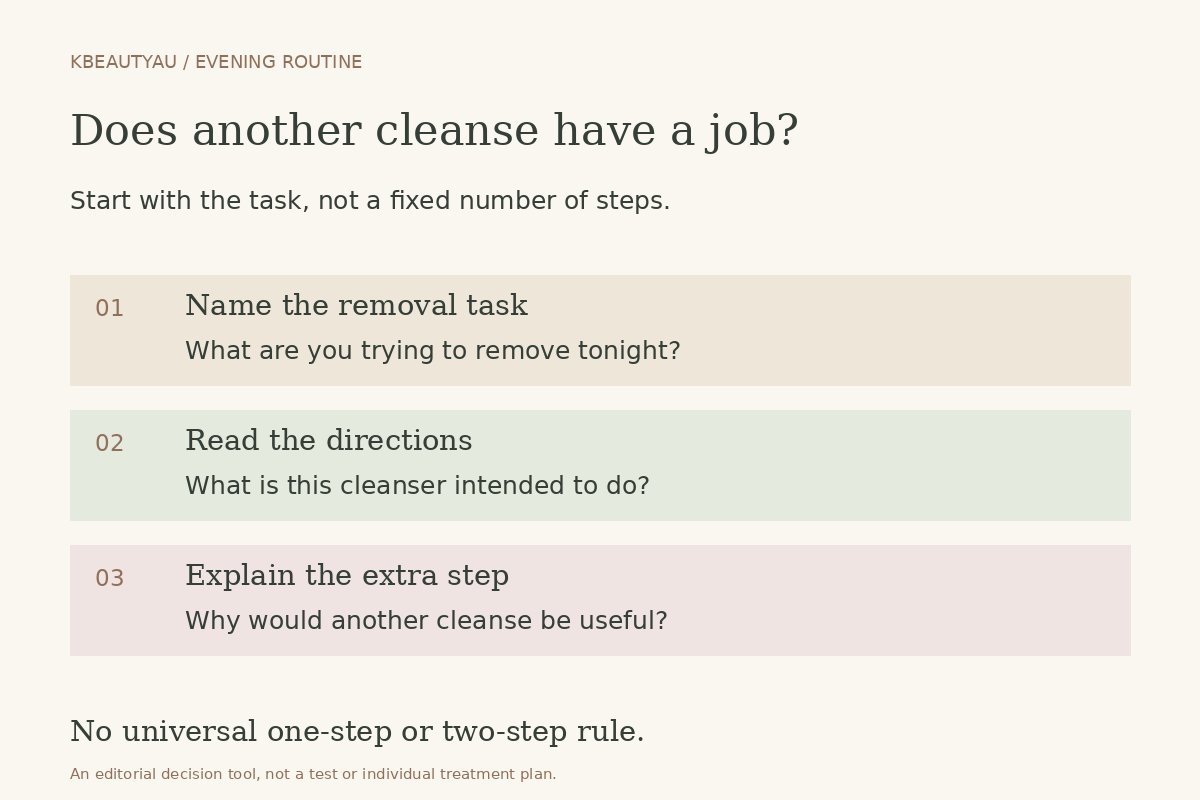
Use these questions as a practical audit:
- What am I removing tonight? Describe the actual task, rather than assuming every day needs the same sequence.
- What is my cleanser designed to do? Check directions and intended use, not just its texture or marketing name.
- Why would I add another step? Finish the sentence before reaching for a second product.
This is a decision framework, not a home test that proves the skin is completely clean. Repeated rubbing, inspecting under magnification or chasing a particular skin sensation should not become the objective.
Oil, cream and foam are starting descriptions
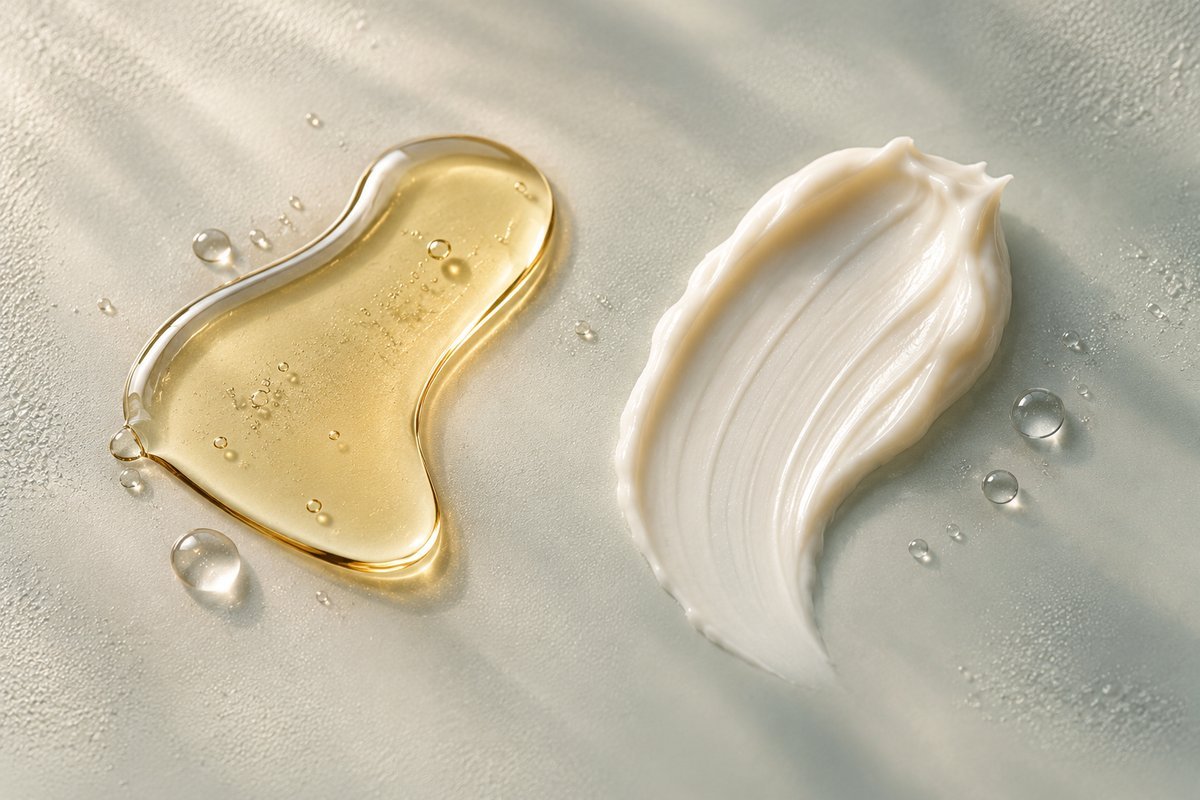
An oil-like texture, a creamy consistency or a foaming format can describe how a formula looks and feels. That description alone does not answer the whole question of whether it suits your routine.
Compare the information you would need before making a choice: intended use, application directions, removal method and any ingredients you already know you need to avoid. If those details are unclear, calling a product “gentle” or “deep cleansing” does not fill the gap.
The material illustration above is not a comparison test, an ingredient analysis or a recommendation to combine the two textures. Its purpose is to make the distinction between a pleasing format and a useful job visible.
A second step should answer a question
Try writing a short note about your current routine before changing it:
- “I use the first step for ___.”
- “The instructions say to ___.”
- “I add the second step because ___.”
If the third answer is only “because everyone does”, you have identified a question worth revisiting. If it refers to a specific removal instruction or advice from your treating clinician, keep that context rather than replacing it with a generic internet routine.
A routine can also vary with the task. The aim is a sequence you can explain and repeat comfortably, not a fixed number of products for every evening.
Do not turn discomfort into a cleansing target
Australian Occupational Dermatology guidance describes how excessive washing and very hot water can aggravate the skin in a hand-care context. That is not a study of facial double cleansing, but it is a reminder that the washing process itself deserves attention, alongside the product.
Source: Occupational Dermatology, Skin Care
For your facial routine, follow the product’s instructions and your clinician’s advice. Do not keep adding passes simply to achieve tightness or a squeaky feeling. If you are uncomfortable after washing, record what you used and how you used it rather than assuming the next solution must be a stronger cleanse.
Keep the review specific: the formula, the sequence, the contact time and any tools you used are separate parts of the story. Changing everything together makes your own observations harder to interpret.
When a routine question needs professional advice
Healthdirect explains that contact dermatitis can involve either irritants or allergens and that cosmetics and soaps can be relevant triggers. A rash cannot be diagnosed by counting cleansing steps. Seek medical advice if you think you have dermatitis, especially if a rash is painful, widespread, sudden or worsening with a product.
Source: healthdirect, Contact dermatitis
Do not stop a prescribed treatment or substitute this general guide for a condition-specific plan. Bring your product list and the sequence you use to the appointment; those details can make the conversation more useful.
Keep the step that earns its place

The useful question is not whether one or two is the correct number for everyone. It is whether you understand the purpose of your own next step.
Tonight, write down the removal task and read the directions before extending the routine. If another cleanse has a clear reason, assess it in that context. If it does not, you do not need to add it merely to complete an imagined K-beauty checklist.
Images include AI-generated editorial scenes and a designed decision graphic. They illustrate the discussion, not a specific product, clinical case or treatment outcome. This is a proposed educational draft for review.