
PDRN Skin Treatment: Before, During and After

B

Written by

Beauty Editor

Most people considering PDRN treatment focus entirely on the sessions themselves. What Korean dermatologists have known for years and what most clinic brochures don't say clearly is that what you do between appointments determines whether the results last. This guide covers the full picture: before, during, and after every session.

6 April 2026·13 min read·
PDRN Skin Treatment: Before, During and After

Not sure your skin type? Take our free 2-minute quiz.

Start quiz →

PDRN Skin Treatment: Before, During and After

Most people considering PDRN treatment focus entirely on the sessions themselves. What Korean dermatologists have known for years and what most clinic brochures don't say clearly is that what you do between appointments determines whether the results last. This guide covers the full picture: before, during, and after every session.


What Is PDRN and Why Does It Matter?

You have probably heard the phrase "salmon DNA skincare" and wondered whether it is serious science or clever marketing. It is the former. PDRN, Polydeoxyribonucleotide, is a purified DNA fragment extracted from salmon, and it has been a cornerstone ingredient in Korean dermatology clinics for well over a decade. Long before it appeared in serums and ampoules on the shelves of Australian clinics, it was being administered as an injectable treatment across Korean, Singaporean, and Japanese aesthetic practices under the brand name Rejuran.

What makes PDRN stand out is not novelty but longevity. Most trending skincare ingredients peak and fade within a cycle or two. PDRN has remained consistent because the results hold up, and because Korean dermatologists continue to reach for it in contexts where other ingredients fall short: sensitive skin, post-treatment recovery, and skin that has lost its ability to respond well to more aggressive actives.

For anyone considering PDRN whether as an injectable treatment or as part of a daily skincare protocol, the most important thing to understand upfront is this: it is a cumulative ingredient. It builds. One session will not tell the full story. The skin's response to PDRN develops across weeks and multiple applications, which is why understanding the full picture; before, during, and after matters so much.


Why Korean Dermatology Uses PDRN Differently

Korean dermatology has a fundamentally different orientation to skin treatment than the approach most Australians are familiar with. Where many Western aesthetic treatments focus on correction resurfacing damage, adding volume, aggressively stimulating turnover Korean clinical philosophy centres on what the skin is capable of doing for itself, given the right support.

This is not a passive philosophy. It is a precise one. Korean dermatologists are not simply leaving the skin to recover without intervention. They are selecting ingredients and protocols designed to work with the skin's own biological processes, rather than override them. PDRN fits this model perfectly because it does not act on the skin from the outside. It interacts with the skin's own repair mechanisms at a cellular level, supporting the environment in which the skin's natural renewal processes can function more effectively.

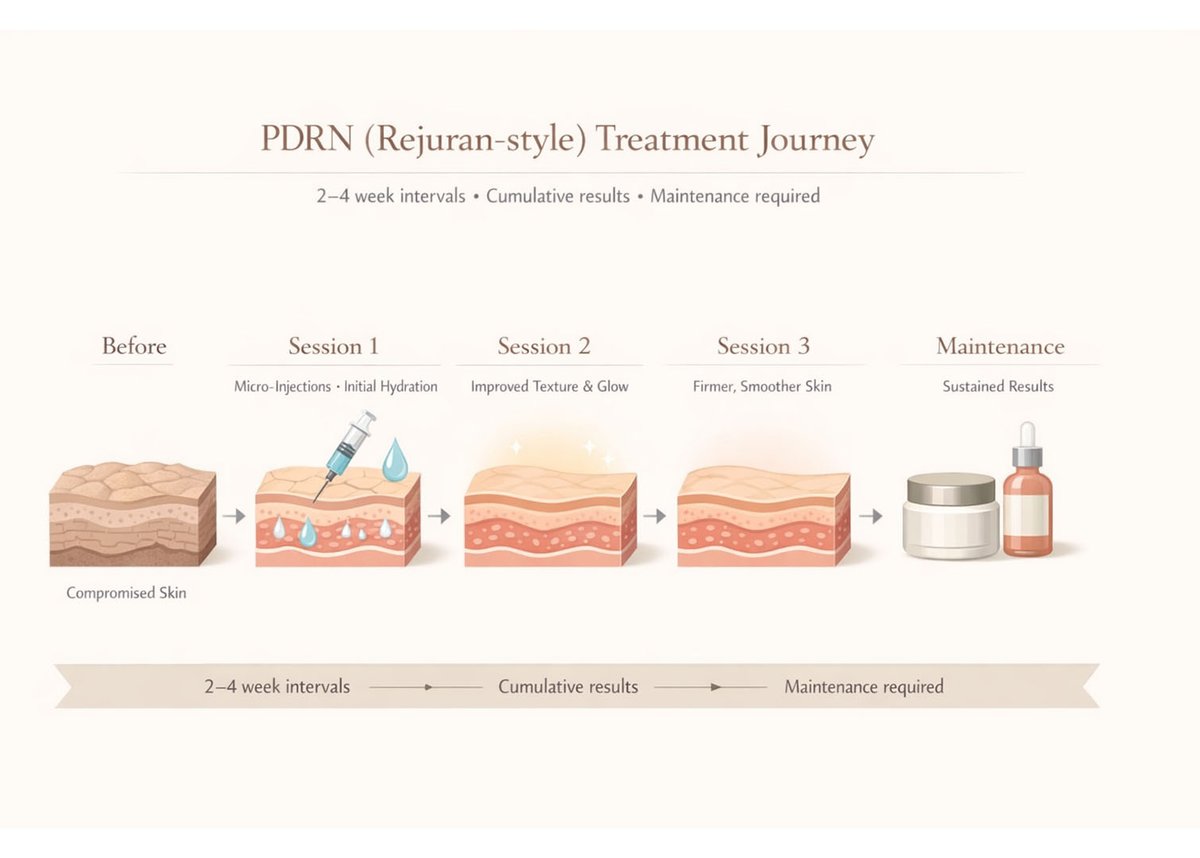
The practical expression of this philosophy is the treatment course. Korean clinicians do not prescribe a single PDRN session and consider the job done. They map a sequence of sessions, typically three as an initial course, then scheduled maintenance, because they understand that the skin needs repeated, supported input to accumulate meaningful change. For anyone used to treatments that show immediate dramatic results, this approach requires a small shift in expectation. What it delivers in return is change that is structural and lasting, rather than surface-level and temporary.


How PDRN Works in the Skin

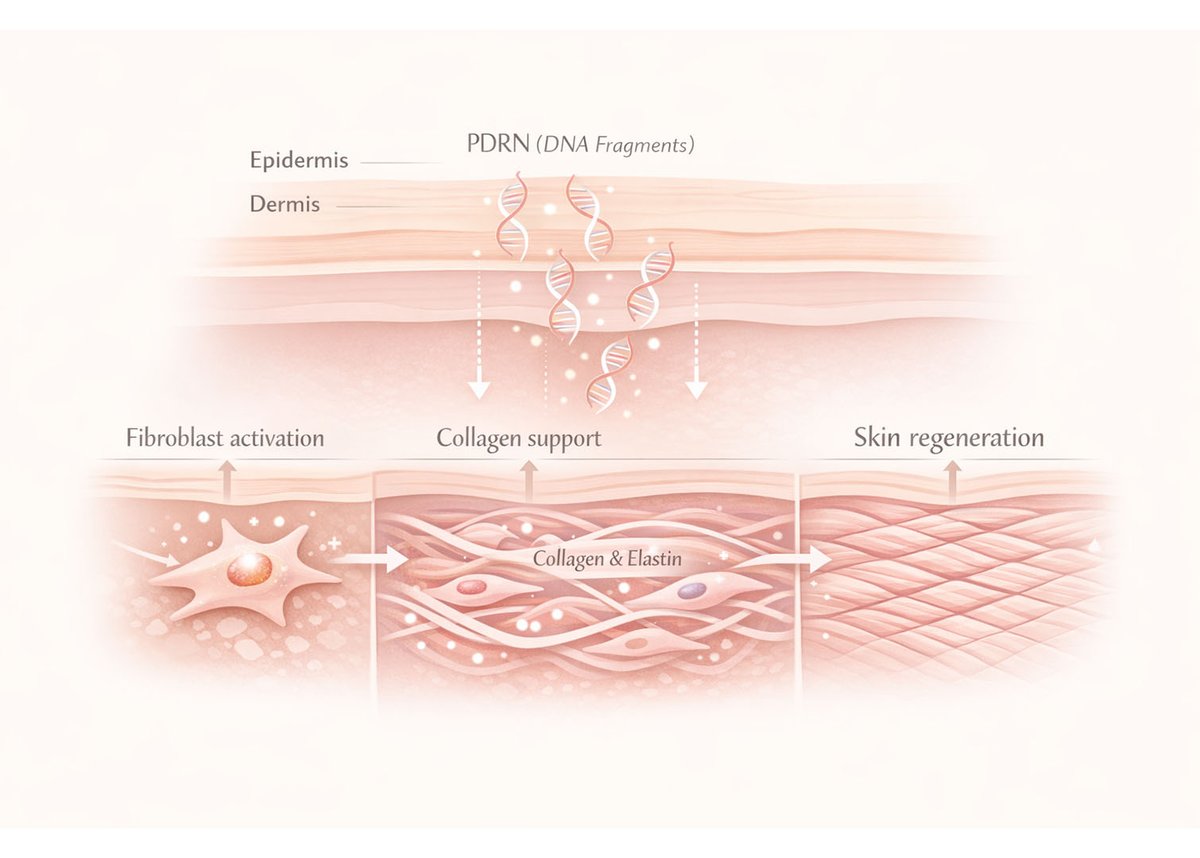
PDRN is a large molecule with a molecular structure that closely resembles human DNA. This similarity is the reason for its well-established biocompatibility: the skin does not treat it as a foreign substance. Instead, it interacts with receptors in the tissue that are involved in cellular activity, supporting the environment in which skin cells can renew and function more efficiently.

The cells most relevant to this process are fibroblasts. These are the cells in the dermis responsible for producing collagen and elastin, the structural proteins that give skin its firmness, elasticity, and density. As skin ages, or as it becomes compromised through sun damage, over-treatment, or barrier disruption, fibroblast activity slows. The skin produces less of what it needs to maintain its own structure.

PDRN supports the skin's natural renewal processes by creating a more favourable environment for fibroblast activity. The visible result, developed over a course of treatment rather than overnight, is skin that appears firmer-looking, more hydrated, more even in texture, and more resilient. These changes do not make the skin look altered or treated. They make it look like a better version of itself. That distinction is important, and it is a large part of why PDRN has built such a loyal following among people who want genuine skin improvement without an obviously cosmetic result.

When PDRN is delivered via injectable treatment such as Rejuran, it reaches the fibroblast-rich layers of the dermis directly. When it is applied through a professional topical formulation, it functions at the skin's surface and upper layers, contributing to a healthier-looking skin condition over time. Both delivery formats have a role. And critically, they work best together, which is one of the central ideas this article will return to.
---

Who Is PDRN Treatment Best For?

PDRN is one of the more versatile treatment ingredients available, which is part of why it has remained central to Korean clinical practice for so long. It does not serve a single skin type or a single concern. It serves multiple profiles, each with a slightly different rationale.

Skin that is showing early signs of ageing responds well to PDRN precisely because it targets the structural layer rather than the surface. If your skin has been feeling less firm, less bouncy, or less hydrated than it once did, and particularly if those changes feel gradual rather than dramatic, PDRN's support of firmer-looking, more resilient skin is directly relevant. It is also a strong option for those who have tried more aggressive anti-ageing treatments and found the recovery difficult or the results inconsistent.

Sensitive and reactive skin profiles are among the clearest beneficiaries of PDRN. The ingredient is well tolerated even by compromised skin, making it appropriate for people who have experienced repeated sensitivity responses to mainstream actives. In Korean clinical practice, PDRN is frequently chosen for clients whose skin has been over-treated and needs a period of supported recovery rather than continued stimulation. The ingredient does not add stress to the skin. It supports the conditions for the skin to manage stress more effectively.

Anyone who has recently undergone a procedure such as laser resurfacing, microneedling, or a chemical peel will find PDRN relevant to their recovery. Both the injectable form and professional topical formulations can support the skin's natural recovery processes following treatment, and the two can be used in sequence to extend the benefit of the original procedure well beyond the clinic visit.

Finally, skin that appears dull, dehydrated, or fatigued, whether from travel, seasonal change, or extended UV exposure, responds well to PDRN's contribution to a healthier-looking, more even skin quality. This is the profile that most often discovers PDRN through a topical formulation first, and then goes on to explore the injectable treatment once they have experienced what the ingredient can do.
CUSKIN

Dr.Solution PDRN Bakuchiol Ampoule 35ml

$78.00 AUD

Shop →

Rejuran Injectables: What Clients Need to Know

Rejuran is the most clinically established PDRN injectable on the market and the name clients are most likely to arrive at your clinic already knowing. It has been widely used across Korean, Singaporean, and broader Asian aesthetic clinics for over a decade, and its arrival in Australia in recent years has brought a significant increase in client enquiries.

Understanding Rejuran from a clinic perspective means understanding what it is and what it is not.

Rejuran is not a filler. It does not add volume or change facial structure. This distinction matters because clients who associate injectables with plumping or lifting may have an inaccurate expectation of what PDRN can deliver. The treatment supports skin quality: hydration, texture, resilience, and the appearance of fine lines over time. The results are gradual, improving across the weeks following each session as the skin responds to the polynucleotide stimulus.

A standard Rejuran course in Australian clinics typically involves three sessions, spaced two to four weeks apart, followed by maintenance treatments every six to twelve months. The procedure itself involves a series of micro-injections administered across the treatment area. Topical numbing is applied beforehand to improve comfort. Some redness and minor swelling is expected after each session, typically resolving within 24 to 48 hours, though this can extend to several days for some clients.

For clinic owners, the course structure of Rejuran is one of its most commercially significant features. A client who understands that optimal results require three sessions, followed by regular maintenance, is a client with a clear reason to return. The role of the clinic is to communicate this structure clearly not as a sales strategy, but as honest clinical guidance that sets realistic expectations and removes uncertainty about what comes next.

What clients experience before their first Rejuran appointment is typically a consultation to confirm suitability, discuss goals, and map the treatment areas. During the procedure, discomfort is generally mild. The appointment duration is usually 30 to 45 minutes. Immediately after, the skin may appear flushed with small raised marks at injection sites, which settle over the following day or two. By the time of the second session, most clients begin to notice changes in skin texture and hydration levels.

What comes between sessions and after the final session in a course, is where topical PDRN formulations become not just complementary but essential.


What to Expect: Before, During and After a Session

Understanding the experience at each stage of a Rejuran treatment is the most practical thing a first-time client can know. Uncertainty about what a procedure involves is one of the most common reasons people delay starting a course they would genuinely benefit from.

Before your first appointment, you will have a consultation with your practitioner to confirm that the treatment is appropriate for your skin, discuss your goals, and map the areas to be treated. This is also when you will receive guidance on anything to avoid in the days prior to your appointment, which typically includes blood-thinning supplements and active skincare ingredients such as exfoliants or Vitamin C on the day itself.

During the session, a topical numbing cream is applied to the treatment area and left to take effect before any injections begin. The Rejuran solution is then administered through a series of fine-needle micro-injections across the mapped areas. The procedure typically takes between 30 and 45 minutes. Discomfort is generally described as mild, though this varies between individuals. Immediately after the treatment, the skin will appear flushed, and small raised marks from the injection points will be visible. These settle within 24 to 48 hours for most clients, though some experience redness for up to several days.

After the session, the instructions given by your practitioner should be followed carefully. In the first 48 to 72 hours, the skin is in an acute phase where it is both vulnerable and particularly receptive. Keeping the routine simple and supportive during this window, avoiding anything active or potentially sensitising, protects the treatment outcome and allows the skin to consolidate the session's effect. SPF is non-negotiable from the morning following treatment. Australian UV conditions mean that any unprotected exposure during recovery can compromise results.

A standard Rejuran course involves three sessions spaced two to four weeks apart. Most clients begin to notice changes in skin hydration and texture by the time of the second session. The full expression of the course's results typically becomes visible over the six to eight weeks following the final session, as the skin continues to consolidate its response.


Why Your Between-Session Routine Matters More Than You Think

This is the section that most treatment guides skip. And it is possibly the most important one.

When you receive a Rejuran injectable session, the skin's response does not stop when you leave the clinic. The weeks that follow are an active phase of the treatment. The skin is processing the stimulus it has received, and what you apply to your skin during that window directly influences how well it consolidates the benefit of the session. A between-session routine that supports the skin's natural renewal processes amplifies the result. A routine that is indifferent to it, or that introduces ingredients the compromised skin cannot handle, limits it.

This is why Korean dermatologists do not treat the topical protocol as optional extra advice. It is part of the treatment plan. A PDRN-based ampoule and cream used consistently between injectable sessions creates a daily extension of the clinical stimulus. Every application supports the skin's renewal environment, builds on the hydration benefit of the previous session, and prepares the skin to respond more effectively to the next one. After a full course, the daily topical protocol becomes the maintenance layer that preserves the result and extends the interval between the injectable appointments needed to sustain it.

For anyone who has invested in a course of Rejuran and then returned to an unchanged routine, this is where the results stall. The injectable does its part. The daily protocol is what allows the skin to do its part.

---

Why Clinics Prefer PDRN-Based Protocols

From a clinical perspective, PDRN has a profile that is difficult to match. Its biocompatibility makes it appropriate for a wider range of skin types than most clinic-grade actives. Its safety record across more than a decade of use in Korean and Asian aesthetic practice gives practitioners confidence in recommending it. And its low irritation profile means it can be offered to clients who have experienced adverse reactions to more aggressive treatments, extending the range of people a clinic can serve effectively.

The course structure of PDRN treatment also creates a natural framework for ongoing client relationships. Rather than a single-session transaction, a PDRN protocol involves a consultation, a structured course of treatment, and a between-session topical protocol that the client uses consistently. Each element keeps the clinical relationship active and purposeful. Clients who are progressing through a treatment plan, and who can see that progress in their skin, have a clear reason to continue. That continuity is what turns a first appointment into a long-term client relationship.


The Bottom Line

PDRN is not new. It is not a passing trend. It is an ingredient with a long, well-documented history in Korean clinical practice, and its arrival in the Australian market through Rejuran injectables and professional topical formulations gives Australian skin a genuinely meaningful option for progressive, structural skin improvement. The results are real. They are also gradual, which is precisely what makes them lasting.

For anyone considering a PDRN treatment course, the key shift is in understanding the investment. A course of Rejuran is not a single event. It is a sequence, and the between-session protocol is part of that sequence. Clients who approach PDRN this way as a sustained commitment rather than a one-off procedure are the ones who see the results Korean dermatology has been building its reputation on.

Korean skincare has always understood that the best outcomes come from consistency, from patience, and from ingredients that work with the skin rather than against it. PDRN is one of the clearest expressions of that understanding available in professional skincare today. Give it the time it is designed to take. The skin will reflect it.

K-Beauty tips in your inbox

Get personalised skincare advice

Join 500+ Australians who get weekly K-beauty routines and product picks.

Take the Skin Quiz →

CUSKIN

Hyaluronic 15 Serum 30ml

$84.00 AUD

Shop →

Exclusive CUSKIN Distributor

Shop CUSKIN Australia

Korean derma-cosmetics shipped from Melbourne

Browse Products →
B

Written by

Beauty Editor

I’m a clinical aesthetic consultant with a deep focus on Korean skincare formulation and treatment protocols. My approach is rooted in barrier-first skin health, where ingredient synergy and long-term skin resilience matter more than quick fixes. Through this platform, I share insights drawn from clinic-based skincare, translating complex K-beauty principles into routines that are both effective and sustainable. My goal is to help you understand not just what to use, but why it works so you can make more confident, informed decisions about your skin.

Comments

Loading comments…

Leave a comment

Share this post

Free · 2 minutes

What does your skin need?

Get a personalised K-beauty routine sent to your inbox.

Take the free quiz →